Maine Munchies Ad

Friday, May 09, 2008

AdWords Agency Blog Response on Parked Domains

Someone from Google's San Francisco office (based on the IP address) left this comment on my New Google AdWords Agency Blog post:
Hi there,

I thought you might be interested in a recent post on the AdWords Agency blog. We read your post about parked domains and it inspired us to publish this one: [link]

Hope you find it useful.
Nice to know that Google's paying attention. ;-)

In that post, they announce a new level of transparency for parked domains on AdWords:
If you're advertising on Google's search or content networks, your ads may be appearing on parked domains. Parked domains are sites using AdSense for Domains, which allows domain registrars to show relevant ads, rather than empty space, on parked pages. But which parked domains did your ads appear on?

We recently added a new level of detail to Placement Performance reports to answer this question. Placement Performance reports give site-by-site performance metrics for the sites where your ads appeared within Google’s content network. Now, rather than seeing one consolidated entry for all parked domains in your reports, you'll see separate rows displaying performance statistics for individual parked domains.
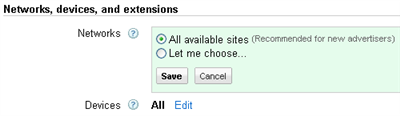
I am pleased to learn they are starting to include more details about parked domain traffic. However, since the Placement Performance reports only apply to the content network, this doesn't help advertisers track AdSense for Domains traffic on the search network. I think it would make more sense for Google to go back to the drawing board and simply split off the AdSense for Domains traffic onto its own network on the AdWords side. I'd like to see this additional ad distribution option:

adwords domain ad distribution

That would avoid much of the confusion caused by the current, rather un-Googley design. Also, I still contend that Google has a miserable failure on its hands. Adding some reporting functionality doesn't solve that problem. Conceptually (yes I read Conceptualist), I do think parked domain ads have potential. The implementation in AdWords doesn't fulfill that potential for advertisers, however. Maybe someone at the Google San Francisco location will make sure this problem gets fixed in a Googley fashion rather than simply patching over the current, poorly designed system?

Apogee Tags: , , ,

Wednesday, May 07, 2008

Mother's Day Flower Delivery for 23 Cents!

Some of my clients are pretty funny. The owner of Plantrex Interior Landscaping Company & Flower Shop is a big sports fan. In light of the Papa John's to offer Cleveland residents 23-cent pizzas fiasco, he's decided to offer 23 cents for Mother's Day Flower Delivery. Use code PAPAJOHNS when checking out. This code is valid today only! Plantrex works with other florists around the nation so this offer is not limited to the Cleveland area.

Here are excerpts of the note he sent to his mailing list:
As a courtesy to everybody I know (feel free to pass onto EVERYBODY) and an opportunity to stick it to the genius that approved those shirts in DC, I have compiled a list of every Papa John’s with phone numbers and addresses that are honoring the 23 cent one topping large pizza on Thursday. I have called over 20 of these stores – they are all opening at 10 a.m. to start taking orders on Thursday. A few are taking orders ahead of time, most are saying you have to call that day.
...

As many of you know, this is my busiest week of the year due to Mother’s Day. I’m a huge Cavs fan so taking time away from my business to do this will cost me but I believe it’s worth it. With that in mind though I am going to plug my company and remind everybody that Mother’s Day is this Sunday and our website is www.plantrex.com.

I am offering a 23 cent delivery for any floral order placed on our website between now and midnight on Wednesday the 7th. To get this discounted delivery, log onto www.plantrex.com, select the item(s) you would like and on the first checkout page, enter the promotional code papajohns and click the submit button. Your delivery fee will be reduced from $7.95 to just 23 cents (your discount will most likely be shown as a reduction of $7.72 off your product – we’re not quite sure how to make it appear on the delivery but bottom line is, you will be paying just 23 cents for delivery).
So, don't procrastinate if you want to send Mother's Day Flowers. Also, keep Plantrex in mind for future floral needs. Their flat delivery fee of $7.95 is better than most online florists, anyway.

Tags: , ,

Thursday, May 01, 2008

Berries for Mom

berries for Mom at Maine MunchiesIf you're searching for berries for Mom, try these gourmet fruit gift boxes. (If you're reading this blog post looking for search engine advertising ideas, skip to the bottom*). I suggest a gift box that features Blue Loon Munch, a combination of dried wild blueberries, dark organic chocolate, and roasted almonds. Looking to spend less on berries for Mom? Try the gift tins.


*When is a Google search like a parked domain? Consider this recent berriesformom.com search:

berriesformom.com search

Subscribe to Apogee Weblog for an explanation in a future post.

Tags: ,

Tuesday, April 29, 2008

Google AdWords Design Flaw - Not So Googley?

After reading What makes a design "Googley" on the Google blog and then an anonymous advertiser comment on my Vulcan Golf v. Google Trial Will Tarnish Google Brand post, I started thinking about an AdWords design flaw. Here's the comment:
when you opt out of the domain ads using the site and category exclusion tool, does it eliminate the ads coming through the search network from the parked domains? not clear here.
Since the site and category exclusion tool was designed for the AdWords content network, its impact on the search network doesn't seem like "Googley" design. I think it violates at least 3 of the 10 stated design principles:
  1. Simplicity is powerful. (Do these instructions seem simple?)
  2. Engage beginners and attract experts. (I think the way Google has implemented parked domains in AdWords takes advantage of beginners and frustrates experts.)
  3. Be worthy of people's trust. (Google's lack of transparency leads to a loss of trust.)
Now, having said all of that, I am pleased Google has introduced this feature. I'm perplexed, though, as to why they haven't announced it on an official blog (maybe Matt Cutts will take care of that). At any rate, this is an important new feature and all AdWords advertisers need to be aware that some aspects of the site and category exclusion tool apply to the search network. So, here was my response:
Yes, anonymous advertiser, opting out of the parked domain page type via the site and category exclusion tool applies to the search network, as well. This is a confusing design by Google since that tool is a content network tool. The What page types can I exclude help page says:

"The AdSense for domains network is encompassed by both the content network and the search network. If you exclude this page type, you'll exclude all parked domain sites, including the ones on the search network."

Also, see the guest post I wrote over at Search Engine Journal, Google AdWords Feature: AdSense for Domains Opt Out. The screenshot in the example is for a campaign that's opted into the search network but not the content network.
Here's the screenshot (not very Googley, IMHO):

not googley adwords tool

Apogee Tags: , , , ,

Saturday, April 19, 2008

Vulcan Golf v. Google Trial Will Tarnish Google Brand

The Vulcan Golf, LLC v. Google Inc. et al lawsuit is going to shine lights in dark corners. For example, read the excellent update from Sarah Bird of SEOmoz:
A trial will tarnish the Google brand. When you think of Google, do you think of cybersquatting or typosquatting? Are you even aware that Google derives revenue by partnering with squatters? I recently wrote a sarcastic post about TANG (Typo Advertising Network by Google). Despite being a joke, the screenshots and the example domain in that post are real.

It's also worth pointing out that Google uses the term squatter on their corporate site. Explaining why a user might see pop-ups, Google writes (emphasis mine):
You may have encountered a squatter with an address similar to Google's. Occasionally, individuals will register domain names that are one letter off from a well-known URL in hopes of attracting those who make mistakes in their typing. Please be sure to enter www.google.com into your browser and the pop-ups may go away.
So, on the one hand, Google's decrying the evils of squatters on their corporate site, while quietly making money from typosquatting. Sorry, Google, you can't play both sides. Either clean up the AdSense for Domains program or drop it entirely. The burden shouldn't be on your customers to somehow stumble across the information needed to block traffic from potential cybersquatters.

When I've found this kind of typosquatting traffic in clients' server logs, they've been shocked that the origin is Google AdWords. A few have contemplated taking legal action. Some have received click fraud refunds from Google. If the Vulcan Golf v. Google case progresses, more advertisers will start to sift through the obfuscated searchportal.information.com URLs to find Google earning money from typosquatting sites like these:
No, I'm not linking to the potential typosquatters. Cut-and-paste them into your browser and see for yourself. These are real examples I've found. I didn't want to post about them in the past because they might impact some clients. However, since it is now possible to opt out of AdSense for Domains traffic in an AdWords account, I can start to post more freely about these kinds of issues.

Does anybody have any examples of their own to share? ;-)

Apogee Tags: , , , , , ,

Thursday, April 17, 2008

Google Earnings (GOOG) Downside

Google earnings (GOOG) beat estimates (via Silicon Alley Insider):
Gross revenue exactly in line with consensus--$5.2 billion, up 42%. Net revenue $3.7 billion, slightly ahead of consensus. Non-GAAP EPS of $4.84 blew away consensus of $4.52.
Before the closing bell, I had guessed net revenue of $3.74 billion and EPS of $4.92. A little high but not too far off. If you're in the search marketing business, you had to know GOOG was doing just fine. I think there's a downside, though, to future revenues. Here's the comment I left on the Silicon Alley Insider post, Google (GOOG) Q1 Game: Step Right Up and Place Your Bets:
Guesstimates:

* Net Revenue: $3.74 billion
* EPS: $4.92
* Friday Open: $489

Google makes quite a bit of money from a hidden network. It's neither search advertising nor contextual advertising. Google has only recently created an opt-out mechanism for this hidden network:

http://adwords.google.com/support/bin/answer.py?answer=86695

Note that a former SVP of SEM firm Efficient Frontier called this kind of traffic "distribution fraud" - it's not quite the same as click fraud. Google that. ;-)

Now, how much revenue will Google lose in future quarters as advertisers start opting out?
Hmm, seeing the $76 surge in GOOG after hours to $525, perhaps the intrinsic value of $1195 calculated by my client, Analytical Investing, is plausible:

GOOG stock analysis

That's still far below the $2000 GOOG target by Henry Blodget. Depending on the time horizon, I don't think that's unreasonable. However, I do wonder if there is some downside risk to GOOG over the next few quarters as they lose AdSense for Domains revenue (much of which they should never have had in the first place, IMHO). I suspect this is why Google hasn't made a public announcement about their new AdSense for Domains opt out. I haven't seen it on either the main Google blog, Inside AdWords or the AdWords Agency blog. Nor have I seen a press release about it. Hmm, does Google not want advertisers to know about it? ;-)

Apogee Tags: , , , ,

Monday, April 07, 2008

Click Fraud: Yahoo + Click Forensics Deal is Not the Answer

I'm not sure how serious Yahoo is about click fraud. Here's what they said on the Yahoo Search Marketing blog about their new partnership with Click Forensics:
We’ve teamed up with Click Forensics, a well-known click auditor that attempts to track click fraud numbers, including publishing quarterly discard rates. The obvious question is, why would we work with a company that has been a critic of search marketing? Because, frankly, we care so much about click quality that we’re willing to work with anybody who can help us—and our advertisers—drive a better return-on-investment.
No, if Yahoo really cared so much about click quality, they'd do one of two things:
  1. Allow advertisers to distribute ads on *only* Yahoo search properties
  2. Enforce better quality standards of the "hundreds of distribution partners and more than one million domains worldwide."
Yahoo knows they have some very, very low quality partners in the Yahoo Search Marketing ad distribution network. Why else would they have created pricing discounts? I think this is worth saying again, in bold:
A discount on low quality traffic is still a premium.
Note that it's possible to buy Google-only traffic via Google AdWords. These are the campaign level ad distribution options:

google adwords ad distribution network

Knowing that click fraud occurs on their search network, Yahoo should give their customers the same type of ad distribution option. Why is there no Yahoo-only choice? These are the ad campaign options:

yahoo search marketing ad distribution settings

Doesn't it just make sense that advertisers have the option to run ads on just search.yahoo.com via Yahoo Search Marketing, if they want? Why is Yahoo reluctant to give advertisers this kind of control over their ad spend?

Apogee Tags: , , , ,

Tuesday, April 01, 2008

Virgle Funded by TANG (Typo Advertising Network by Google)

In the Virgle project announcement, Google forgot to mention how they're going to fund the endeavor. Even TechCrunch doesn't have the details. You will not believe Google's latest advertising venture. It's called TANG (Typo Advertising Network by Google). Here's an exclusive Q & A with a spokesperson about how this typo advertising system will generate revenue for Virgle:

Q: What's TANG?
A: Typo Advertising Network by Google (TANG) is revolutionary way to profit from typing mistakes. When users type in the wrong domain name, we'll display ads for contextually relevant keywords. We know what they were thinking so can offer compelling ads.

Q: Um, doesn't that already exist as AdSense for Domains?
A: Shh. TANG sounds better, especially for a spacefaring venture.

Q: Can you give us an example?
A: Sure, let's say someone types amazingpornstrar.net into their browser. This is what they'll see:

amazingpornstrar.net typo domain

Q: Gosh, that's ugly. Why would anyone type in a .net instead of a .com? And, how is search for "credit card applications" relevant for a typo of amazingpornstar.net?
A: We've found that most people who can't type well tend to navigate to .net instead of .com domains. Also, if they're looking for that kind of a site, they clearly need a new credit card. It's not that the CPCs are high for those keywords. No, no. It's that our contextual targeting is so accurate that if someone types amazingpornstrar.net then they are really searching for a new credit card. We know these things.

Q: Is this really good for advertisers?
A: Oh, sure. This goes a step beyond our expanded matching system. They'll get additional search clicks for keywords they would never even thought to have entered into the AdWords system.

Q: So, are these ads distributed on the AdWords search network or content network?
A: Both, of course. TANG, like AdSense for Domains, encompasses both of the traditional Google advertising networks. It's everywhere. Google will make more money for Virgle with the higher CPCs on the search network, but that's not why we run the ads on that network. We just know through our contextual ad technology which search ads correspond to typos.

Q: Is it clear to users that these are paid ads?
A: No, that would lead to fewer clicks for advertisers and less revenue for Virgle. Besides, these people who can't type don't read very well, either. There's no need to add extra text indicating which content is actually advertising. The TANG ads are exempt from the petty AdSense policies like:
Ads shouldn't be placed under a title or section heading in a way that implies that the ads are not ads.
Q: Can you give me an example?
A: Sure, let's continue the previous example. After navigating to amazingpornstrar.net, a user will likely click on a contextually relevant search like "credit card applications" which will lead them to these results:

parked domain ads for credit card applications

Q: So, those are all AdWords ads designed for the search network?
A: Yep. Like I said, higher CPCs. More clicks. Everyone wins.

Q: Can advertisers opt out of TANG?
A: Sure, they can use the new AdSense for Domains opt out mechanism. But why would they want to?

Apogee Tags: , , , , , , ,

Monday, March 31, 2008

New Google AdWords Agency Blog

There's more to be said about Google's miserable failure. In the meantime, I've stumbled across a new blog from Google, The AdWords Agency Blog. Looks promising.

Google AdWords Agency Blog

Do you think they'll suggest blocking parked domains from search advertising campaigns? Nah, I didn't think so, either. ;-)

Apogee Tags: ,

Saturday, March 22, 2008

Google's Miserable Failure

Distribution fraud is Google's miserable failure. This particular post is a continuation from AdWords Advice: Ban Parked Domains in Search Advertising Campaigns. Please read that before the rest of this post. If you want background going back a couple of years, start with this very detailed post: Not Search Engine Spam. The fact that Google has been well aware of this problem for years is part of their miserable failure.

There are two key reasons I'm calling distribution fraud Google's miserable failure:
  1. Google's failure to protect advertisers from fraud
  2. Google's failure to organize the world's information
Let's start with point #2. Google has declared that its core mission is "to organize the world's information and make it universally accessible and useful." However, there is some information they are well aware of but have chosen to hide, in the reports they provide to AdWords advertisers:

parked domain ads reporting failure

How does Google explain the decision to detail clicks from individual domains on their pay per click advertising network but to hide the individual parked domains from advertisers? Over nine months ago, they said (emphasis mine):
The Placement Performance report provides site-by-site performance metrics -- including clicks, impressions, cost, and conversion data -- for domains or URLs in the content network where your ads have appeared. The report also provides a new level of transparency for traffic you accrued from sites in our network that are participating in the AdSense for domains program. Currently, AdSense for domains statistics are collectively reported, but we are working to give you site-by-site level statistics soon.
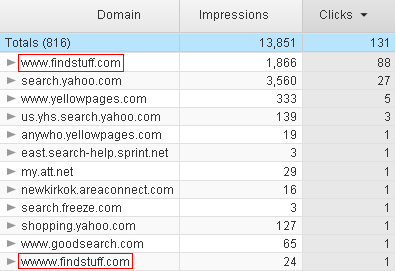
After almost a year, they still haven't organized this information for advertisers! That's a miserable failure. For a company that develops new products and services at the pace that Google does, this is a stunning failure. I'm not convinced they will ever complete their mission. So, I'll organize some of this information for them. I wanted to know the source of these 916 clicks from parked domains on the search network (NOTE: content network was OFF for this campaign):

adense for domains clicks

I dug through web server log files to find the origin of these clicks. I was stunned to see where they came from. To borrow a phrase from renowned domainer, Frank Schilling, it will "blow your hair back" to see the high quantity but very low quality of these domain names. Here's a sample of the garbage traffic on the Google AdWords *SEARCH* network:
  • 555sss.com
  • abtanet.com
  • allinz.com
  • amazingpornstrar.net
  • amexassurance.com
  • autohu.com
  • b.com.cn
  • babrie.com
  • bodjoj.com
  • buding.cn
  • clikjogos.com
  • europassist.com
  • iaj.cn
  • infotube.tv
  • jshopper.com
  • manullife.com
  • noo.net
  • roter.com
  • sekstutkunu.com
  • sexpaty.tv
  • specialityrisk.com
  • thaionlinemaket.com
  • topmusicasnet.com
  • travelgaurd.com
  • tubou.cn
  • tutkusu.com
  • ufeng.net
  • wuae.cn
  • wwwbmg.com
  • xirin.cn
  • xise.com.cn
  • zfotoz.com
  • zoili.com
  • zzxxx.com
Now do you understand why Google has a miserable failure on their hands? Can you believe advertisers are unwittingly paying for this, for lack of a better term, crap? Can you see why Google chooses to aggregate domain ads clicks in reports rather than detail individual parked domain names? Domainers, can you see why PPC advertisers are wary of parked domains? These are not generic keyword domains. These don't belong on the AdWords search network. I don't think they even belong on the content network. For this reason, I repeat my advice to block parked domains on the search network.

I honestly cannot believe that Google turns a blind eye to this sort of garbage traffic on their own advertising network. They claim to sift through their log files to help prevent fraud. Don't they see this traffic? Note that the actual parked domains are not visible in the log files. All of the clicks are routed through complex URLs with domain names like:
I think someone at Google recognizes they have a miserable failure on their hands. They simply cannot fulfill their mission to organize the world's information because that would reveal the fact that Google is profiting from typosquatting. Instead, they've decided to let advertisers opt out of AdSense for Domains traffic. Unfortunately, that means advertisers will be losing some good traffic from valuable generic keyword domains. It also doesn't go far enough. Google should apologize for their wrongdoing, proactively issue retroactive refunds for this garbage traffic, and keep search network traffic clean going forward.

What do you think? Is this a miserable failure or something else?

Apogee Tags: , , , , , ,